You Don't Have a Motivation Problem. You Have a Foundation Problem
Losing motivation for the same goal, over and over, isn't a motivation problem. It's a cracked foundation — and you can't fix it by renovating the terrace.


Quick answer: If you keep losing motivation for the same goal over and over, motivation was never the actual problem. Motivation is renewable — it comes back on its own, every time, which is exactly why it can't be the thing that's broken. What doesn't come back on its own is a cracked foundation: an old belief still deciding, quietly, what you're allowed to build on top of it. You can renovate the terrace as many times as you want. It cracks again in the same place, because nobody ever looked at what it's actually standing on.
Here's a pattern I want you to notice, because once you see it, you can't unsee it.
You get motivated. You start. For a week, maybe three, you're the version of yourself you keep trying to become. And then — quietly, without a dramatic reason — you stop. Not because you failed. Not because something went wrong. You just... drift back to where you started.
And then, weeks or months later, something lights you up again. New year. New book. New person who said the right thing at the right moment. You get motivated again. You start again. And the cycle repeats, right on schedule, like a subscription you forgot to cancel.
If this is you, I want to offer you something that might actually be a relief: you don't have a motivation problem.
Why "just find your motivation" keeps failing you
Motivation is not a scarce resource. It's not something you either have or don't have, like a bank balance you can drain to zero. Motivation is renewable. It comes back. It always comes back — that's actually the whole tell.
If the thing that was broken was your motivation, and motivation keeps coming back, then the problem would keep fixing itself. But it doesn't. You get the spark again, and the same thing happens again. Which means the spark was never the issue. Something underneath it is catching fire and going out, over and over, on a loop that has nothing to do with how badly you want it.
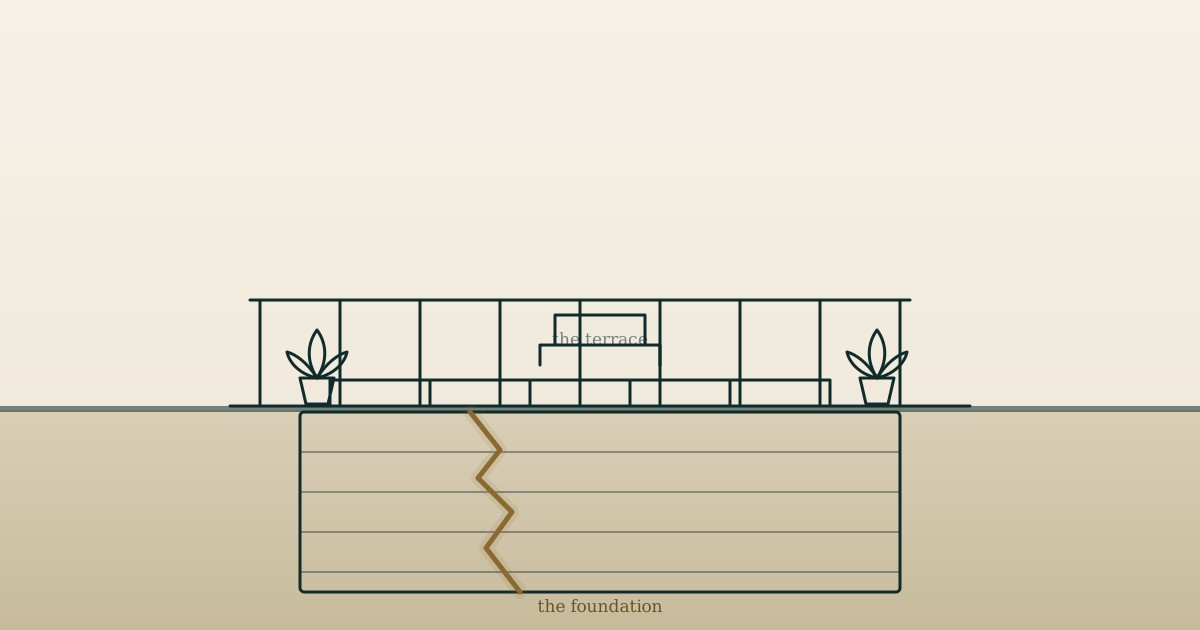
Here's the metaphor I use with almost every person I work with, because it's the one that actually makes people stop and go quiet for a second: you cannot fix a cracked foundation by renovating the terrace.
You can repaint it. Retile it. Add better furniture, better lighting, a better view. It will look completely different for a while. And then, because the ground underneath was never actually solid, the same crack finds its way back through — right where it always does.
Most growth advice, most productivity content, most "5 steps to change your life" content — it's all terrace work. It's not wrong, exactly. New habits, better time management, clearer goals — these things do help, for a while. But if the foundation underneath them is cracked, none of it holds. You'll do the work, feel the shift, and then watch it crack again in the exact same spot, and conclude — wrongly — that you're just not disciplined enough to make it stick.
You were never undisciplined. You were renovating a room built on a foundation nobody checked.
What does a foundation problem actually look like?
This is the part that's hard to see from the inside, because a foundation problem doesn't announce itself as a foundation problem. It shows up disguised as something else entirely.
It looks like starting the same project three times and never finishing it — and each time, telling yourself the timing just wasn't right.
It looks like reaching the edge of something good — a launch, a promotion, a relationship going well — and quietly finding a reason to pull back, right when it was working.
It looks like knowing exactly what you need to say to someone, rehearsing it in the shower, and then not saying it, again, for the fourth month in a row.
It looks like burning out doing everything yourself, being handed the exact tools to delegate it, and somehow still doing it all yourself six months later.
None of these are motivation problems. Nobody lacks the motivation to stop being exhausted. What's actually happening is a belief — usually one you didn't choose, usually one that formed a long time before any of this — deciding, on your behalf, what's safe to finish, what's safe to receive, what's safe to say out loud.
Why does trying harder never fix it?
Because trying harder is a terrace strategy applied to a foundation problem. It's the wrong tool for what's actually broken — not because you're using it badly, but because it was never designed to reach that deep.
Willpower operates on the part of you that consciously decides things. Beliefs operate underneath that, in the part of you that decided a long time ago what's dangerous and what's safe, and hasn't been consulted since. You can out-argue your conscious mind. You cannot out-argue a belief you don't know you're holding.
This is also why the shame that comes after failing again is so unfair, and so misplaced. You're not failing because you're weak. You're failing because you keep bringing a paintbrush to a structural problem, and then blaming yourself when the wall cracks again. The paintbrush was never going to fix that wall. It was never the right tool, no matter how skillfully you used it.
Where do these foundation beliefs actually come from?
Almost always, somewhere ordinary. Not always a dramatic event — sometimes just a repeated small message, absorbed early, before you had the ability to question it.
A belief that being wrong in front of people is dangerous, because once, being wrong got you laughed at, or punished, or quietly withdrawn from.
A belief that visibility is risky, because the one time you stood out, it came with a cost you didn't expect.
A belief that you have to earn rest, because somewhere along the way, stopping got equated with being lazy, or letting people down, or not being enough.
These beliefs did a job once. They protected you from something real, in a context that made sense at the time. The problem isn't that the belief was wrong when it formed. The problem is that it never got updated — it's still running the exact same protection protocol on a life and a business that look nothing like the one it was built for.
Across 500+ advisory sessions, the single most common pattern I see isn't a skills gap. It's a founder running a decade-old protection script on a problem it was never built to solve.
So how do you actually fix a foundation problem?
Not with a framework. I want to be honest about that, because it's the part that makes this genuinely different from most of what you'll read on this topic.
A framework assumes you know what's broken and just need steps to fix it. A foundation problem is the opposite situation — you don't yet know what's actually broken, because it's been operating underneath your awareness this whole time. Steps are useless against something you can't see.
What actually works is naming it. Specifically, honestly, out loud — not "I'm just not motivated," but the real sentence underneath: I'm afraid that if I finish this, I'll have to keep being this person, and I don't know if I can. Or: I'm afraid that if I say this to my co-founder, I'll find out the relationship was never as solid as I needed it to be. Or: somewhere, I decided that resting means I'm not trying hard enough to deserve what I have.
You cannot fix what you haven't named. And most people go their entire lives cycling through motivation, burnout, and shame without ever once naming the actual sentence — because nobody taught them how to find it, and every framework they were handed instead assumed the sentence didn't need finding at all.
This is the actual difference between coaching-as-usual and the work I do. I'm not going to hand you a 5-step system and wish you luck with the foundation. Twelve years of counselling before I ever worked with a single founder taught me how to find that sentence — the real one, not the polite one — and once it's found, the systems and habits and frameworks you already know finally have something solid to stand on.
Isn't this just therapy with extra steps?
Fair question, and worth answering directly instead of dodging it.
Therapy is often open-ended, and rightly so — it can go wherever the person needs it to go, over however long that takes, and it's an essential, different kind of work that I'm not trying to replace or compete with.
What I do is narrower on purpose. I'm not exploring your whole life story. I'm looking for one specific thing: the belief currently sitting underneath the exact pattern that's costing you growth, right now, in your business or your leadership. Twelve years of counselling training is what lets me find it accurately instead of guessing — but the work stays scoped to you as a founder and a leader, not an open-ended process. Think of it less like therapy, and more like a structural inspection before anyone touches the terrace again: focused, specific, and done once the crack is actually found.
That distinction matters, because a lot of people avoid this kind of work entirely, thinking it means opening up everything. It doesn't. It means finally looking at the one thing that's actually been driving the pattern you've been fighting for years — and then stopping the fight, because you're no longer fighting the wrong thing.
The terrace can wait
If you've read this far and something in you went quiet — that's usually a good sign, not a bad one. It means some part of you already knows which sentence this is about.
You don't need another framework right now. You don't need to try harder, or find your motivation again, or start Monday with a cleaner slate. You need someone to help you look at the actual foundation, honestly, before you spend one more ounce of energy repainting a terrace that was never the problem.
That's the work. Not the terrace. The thing underneath it.
FAQ: Is a "foundation problem" the same as low motivation? No — motivation is renewable and always comes back, which is exactly why it can't be what's broken.
Can you fix it with willpower? Not directly — willpower is conscious, the belief driving it isn't.
How do you find your own? By naming the real sentence underneath the pattern, honestly — usually not something people can do entirely alone.


Newsletter
Subscribe now to stay updated with top news!
Subscribe to our newsletter and be the first to access exclusive content and expert insights.

