The Root & Branch Method: Why You Don't Have Four Problems, You Have One
why do I have the same problem in different areas of my life, root cause vs symptom, one belief many problems


Quick answer: Most people think they're juggling separate problems — money stress, health issues, relationship friction, career anxiety. Usually, it's one problem: an unexamined belief, formed long before any of these situations existed, now showing up in four different places at once. The Root & Branch Method is how I find the root and work backward from there, instead of treating each branch as its own separate fire.
Every founder and every high-achiever I've worked with arrives with a list. Sometimes it's long. Money's tight and it shouldn't be. Sleep's gone. A relationship has some quiet strain in it that never quite gets addressed. Work feels like it's costing more than it's giving back.
They usually describe these as four separate problems, needing four separate fixes.
Here's what I've found, across years of doing this work: it's almost never four problems. It's one belief, wearing four different outfits.
This is the framework behind everything I do. I call it the Root & Branch Method — one root, four branches, in that order.
Why does it look like four problems when it's really one?
Because each branch has its own surface — its own conditions, its own visible symptoms, its own obvious fix. Money problems look like they need a better budget or a bigger revenue number. Health problems look like they need more sleep or less stress. Relationship problems look like they need better communication. Work problems look like they need a new role or a new structure.
Each of those fixes is real. None of them touch what's actually driving the pattern — which is why fixing one branch rarely fixes the others, and why the same branch tends to grow back even after you've "solved" it once.
What is "the root," exactly?
The root is a belief — usually one you didn't consciously choose, usually formed long before the situation it's now running. It answers one specific question underneath everything else: is this belief still true, or did you just stop checking?
Most people never ask that question, because the belief doesn't announce itself as a belief. It shows up as a feeling that seems like fact — "I can't let this go," "I have to earn rest," "if I say this, I'll lose them," "if they really saw my work, they'd find something wrong." It feels less like an opinion and more like weather. Something you're just standing in.
What are the four branches?
The root shows up in four places, consistently, across almost everyone I've worked with:
Money — your relationship with risk. What you believe you're allowed to have, and what you believe it costs to go after more of it.
Health — your relationship with rest. Whether rest is something you're allowed to take, or something you have to earn first.
Relationships — your relationship with conflict. What you believe honesty costs you, and whether the relationship can survive it.
Work — your relationship with being seen. What you believe happens if people actually look closely at what you've built.
These aren't four separate skills you learn independently. They're four rooms the same belief walks into.
What is "the method" — the actual steps?
Three, in order, and the order matters.
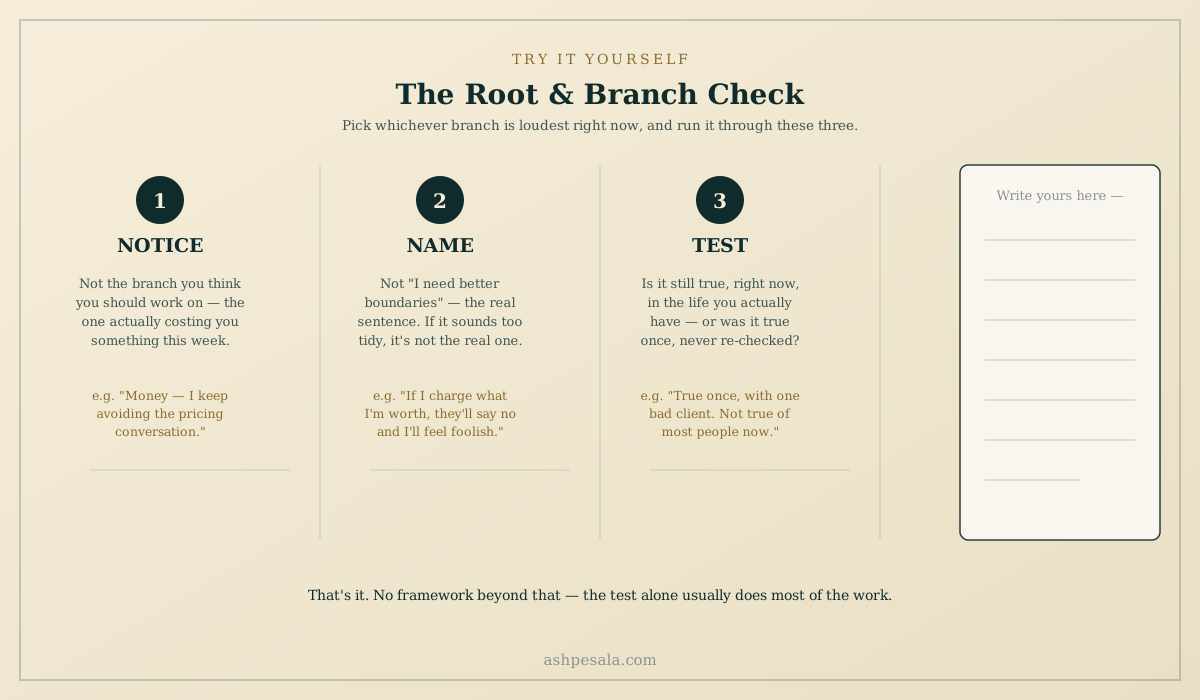
1. Notice. Which branch is loudest right now? Not which one you think you should be working on — which one is actually costing you something this week.
2. Name. What's the belief underneath the pattern, specifically? Not "I need better boundaries" — the real sentence: "I'm afraid that if I say no, they'll realize they don't need me." Specificity is what separates a root from a surface diagnosis.
3. Test. Is that belief actually still true? Most of these beliefs formed to protect you from something real, once, a long time ago. The test isn't whether it was ever true. It's whether it's still true now, in the life and the business you actually have today.
Across 500+ advisory sessions, the single most common finding isn't a skills gap in any one branch. It's the same root belief showing up in two or three branches at once, being treated as unrelated problems the entire time.
How do you know which branch to start with?
Start with whichever one is loudest, not whichever one seems most "important." Loud is data. A quiet, chronic problem you've learned to live around is often actually further from the root than a branch that's genuinely urgent right now — urgency tends to strip away the polite version of the problem and get you to the real sentence faster.
Try it yourself — the Root & Branch Check
The branches were never the problem
If you've been fixing the same branch over and over — a new budget, a new sleep routine, a new communication framework — and it keeps growing back, that's not a discipline problem. That's a sign you've been pruning a branch instead of reaching the root. The fix that keeps wearing off is usually doing exactly that.
The root doesn't need four different solutions. It needs one honest look. Once that happens, the branches tend to sort themselves out — not instantly, but reliably, because you're no longer fighting four separate fires that were actually one.
Frequently asked
Is the Root & Branch Method a type of therapy? No. It draws on real counselling training to find the belief driving a pattern, but the work stays scoped to the specific pattern costing you growth right now — not an open-ended process.
Do I have to work on all four branches at once? No — usually one branch is louder than the others at any given time. Start there. Because the branches share a root, progress on one often loosens the others too.
How is this different from typical goal-setting or habit frameworks? Most frameworks work at the branch level — a better budget, a better routine, a better script for hard conversations. The Root & Branch Method starts one level down, at the belief generating the pattern those frameworks are trying to manage.
If this described something you recognized, take the free 60-second assessment or book a confidential call.


Newsletter
Subscribe now to stay updated with top news!
Subscribe to our newsletter and be the first to access exclusive content and expert insights.

