How to argue without fighting?
How to fight fair in a relationship, why do arguments get personal, how to disagree without hurting the relationship


Quick answer: The one practice that makes the biggest difference is to fight the problem, not the person. Most arguments don't go wrong over the disagreement itself — they go wrong the moment it stops being the two of you against a problem, and becomes one of you against the other. Stay on the same side as the person you're talking to, and the disagreement stops needing to turn into a fight at all.
This is one of the few things I practice myself, every time, because I've seen what happens when I don't.
A disagreement starts over something specific — a decision, a missed deadline, a hurt feeling. And somewhere in the middle of it, without anyone deciding to, the conversation quietly changes shape. It stops being "how do we solve this" and becomes "how do I win this." The problem is still technically on the table. But now it's you against them, not the two of you against it.
That shift is the whole thing. Everything else is details.
Why does an argument turn into a fight?
Because the moment something feels like an attack, your mind stops trying to solve it and starts trying to defend against it.
Think about what actually happens in your body when someone says "you always do this" instead of "this specific thing happened, and it bothered me." The first one lands as a verdict on who you are. The second one lands as information about an event. You can work with information. You can't do much with a verdict except defend yourself against it — and defending yourself and solving a problem are two completely different activities heading in opposite directions.
Once defense mode kicks in, the actual issue barely matters anymore. The fight is just two people trying not to lose.
What does "fight the problem, not the person" actually mean?
It means treating the issue as something you're both looking at together, not something one of you is doing to the other.
With a parent, it might mean the difference between "you never respected my choices" and "I've felt unheard on this one decision, and I want to understand why." With a partner, it's the difference between "you don't care about this family" and "I think we see this differently, and I want to figure out why." With a child, it's the difference between "you never listen to me" and "I've asked you twice now, and I want to understand what's making this hard for you right now." With someone at work, it's the difference between "you dropped the ball again" and "this deadline slipped — let's figure out what actually happened."
Same disagreement. Completely different conversation. In the first version of each, the other person has to defend themselves before anything else can happen. In the second, they're free to actually think about the problem with you.
What does this look like in practice?
A few small, specific shifts carry almost all of the weight:
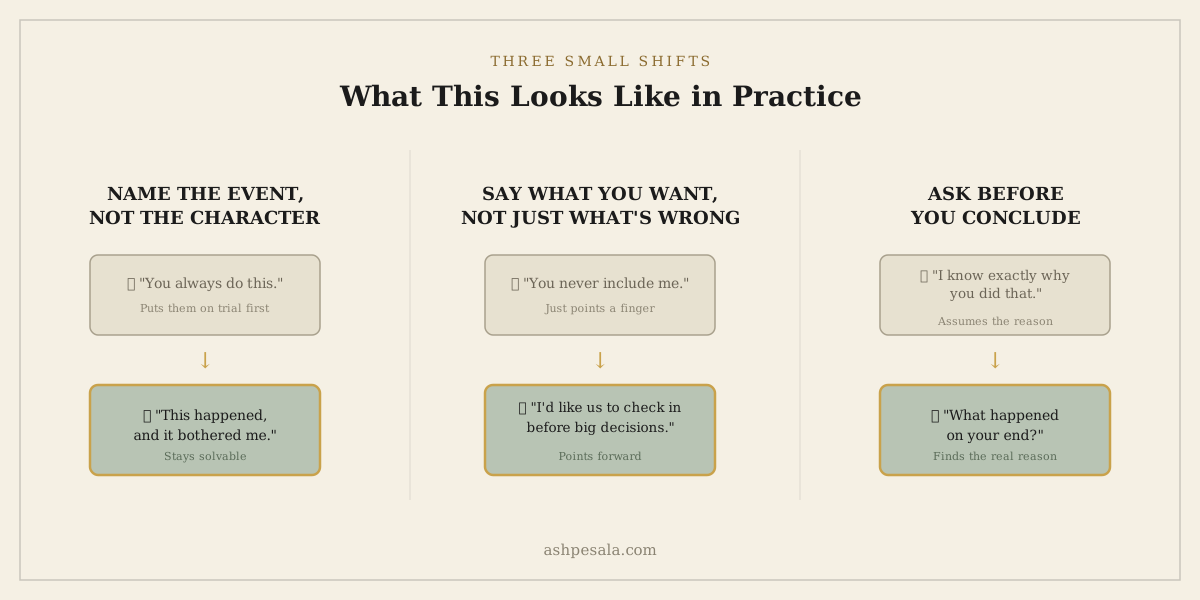
None of these are complicated. They're just the difference between talking to someone and talking at them.
Across 500+ advisory sessions, the relationship pattern I see most often isn't a communication skills gap — it's two people who are both genuinely trying to solve the same problem, who've somehow ended up on opposite sides of it anyway.
Why doesn't "just communicate better" fix this on its own?
Because communication skills assume both people are already on the same team. The skill tells you how to phrase something. It doesn't touch the belief that made you feel like you had to defend yourself in the first place.
If some part of you believes conflict means the relationship is at risk, or that being wrong about something small means you're wrong as a person, no phrasing trick survives that belief for long. You'll say the "right" words and still feel like you're under attack — because somewhere underneath, you believe you are.
This is the same root the rest of the work keeps coming back to: name the belief, not just the behavior, and the better words start showing up on their own.
Try it this week
Next time you feel a disagreement starting to turn into a fight, pause and ask yourself one question: am I trying to solve this with them, or win this against them?
You don't have to fix the whole conversation. Just notice the moment it shifts. That alone changes what happens next more than any script you could memorize.
The problem was never the enemy
Every relationship that lasts — with a parent, a partner, a colleague — has disagreements in it. That was never going to be avoidable, and it isn't actually the thing that damages the relationship.
What damages it is forgetting, somewhere in the middle of being upset, that the person across from you isn't the problem. They're the person you're supposed to be solving it with.
Frequently asked
How do I stop an argument from turning personal?
Catch the shift early — the moment the conversation moves from a specific event to a verdict about someone's character ("you always," "you never"). Naming the specific thing that happened, instead of the pattern or the person, keeps the conversation solvable.
Does this work with a parent, not just a partner?
Yes — the same shift applies anywhere the relationship matters more than winning the specific disagreement. The dynamic is identical whether it's a parent, a partner, or a colleague; only the history underneath it is different.
What if the other person is the one making it personal?
You can't control that, but you can hold your own side of it — staying on the problem, not escalating into a counter-attack, often changes the tone of the whole conversation even when you didn't start it that way.
If this described something you recognized, take the free 60-second assessment or book a confidential call.


Newsletter
Subscribe now to stay updated with top news!
Subscribe to our newsletter and be the first to access exclusive content and expert insights.

