You Stopped Growing at 21. Your Mind Didn't Have To
So a lot of people simply stop choosing it. Not on purpose. They just never realized it was still theirs to choose.


Quick answer: Physical growth stops around age 21. Mental growth doesn't have a deadline — but most people quietly stop growing it around the same age anyway, simply because nobody ever told them it was still available. That one root, how examined or frozen your beliefs are, is what actually shapes your money, health, and relationships. Not four separate skills. One root, four branches.
We stop growing physically around 21. Nobody argues with that. Your height was never going to be a decision you made — it just happened, on its own schedule, and then it stopped.
Somewhere along the way, a lot of people quietly apply the same rule to everything else. As if growth had one deadline, and once you hit it, you're just done. Set. Whoever you are now is who you'll be from here.
Here's what I think actually happens: the body stops. The mind doesn't have to.
Why does mental growth quietly stop when physical growth does?
Not because it has to. Because nobody ever drew a clear line between the two.
Growing up, growth is something that happens to you. Your body does it automatically, without your input, and it clearly stops around 21. So a quiet assumption forms early: growth is something that happens, then finishes. Nobody ever explains that mental growth is a different kind entirely — one you now have to choose, on purpose, instead of just receiving.
So a lot of people simply stop choosing it. Not on purpose. They just never realized it was still theirs to choose.
Why is mental growth the root of everything else, not one category among many?
Because your relationship with risk shapes your money. Your relationship with rest shapes your health. Your relationship with conflict shapes every relationship you're in.
None of these are separate skills, learned independently. They're all downstream of the same mind — the same beliefs about what's safe, what you deserve, what happens if you're actually seen. Fix the money without touching the belief about risk underneath it, and the same pattern shows up again, in a different bank balance, a few years later. This is the same idea underneath Personal & Health Growth — one root, not five separate fixes.
What does a "frozen" mind actually look like day to day?
It doesn't look dramatic. It looks ordinary, which is exactly why it's easy to miss.
It looks like being 45 and reacting to conflict exactly the way you did at 19. It looks like having ten more years of experience, but the same fear of being wrong you had at your first job. It looks like running a business ten times bigger than when you started it, led by someone whose relationship with money never actually grew past wherever it was on day one.
More years doesn't automatically mean more growth. Sometimes it just means more time spent quietly confirming the same old belief.
Why doesn't experience alone keep you growing?
Because experience without reflection just repeats.
You can live through the same pattern for twenty years and get very good at surviving it, without ever actually examining it. Growth requires something experience alone doesn't provide: an actual decision to look at the belief directly, instead of just getting better and better at working around it — the same pattern explored in why procrastination is usually fear, not laziness.
Across 500+ advisory sessions, the founders who've grown the most in their business are almost always the ones who kept growing their relationship with themselves — not the ones with the most years of experience.
What actually keeps mental growth going?
Not more information. Most people already know more than they act on.
What keeps mental growth going is the willingness to keep questioning beliefs that used to be true, and might not be anymore, on purpose and regularly — instead of waiting for a crisis to force the question.
How do you actually know if you're still growing?
Not by how busy you are. Not by how much has changed on the outside — a bigger business, a bigger house, a longer resume. Those can all grow while the mind underneath them stays exactly the same.
The real test is simpler, and a little uncomfortable: think of a decision you'd have made five years ago, in a situation similar to one you're in right now. Would you make the same one today, for the same reasons? If the honest answer is yes — the same fear, the same hesitation, the same story about what you can and can't do — that's not consistency. That's the mind sitting still while everything around it moved.
Real mental growth usually shows up as a small, specific shift: a belief you'd have defended firmly a few years ago that you'd now genuinely question. Not because someone argued you out of it. Because you looked at it again, on your own, and it didn't hold up the way it used to.
If you can't think of one — not one belief that's actually changed in the last few years — that's worth sitting with. Not as a failure. As information about where to look next, the same way naming the real fear underneath a stuck pattern is where the actual change starts.
A quick activity to try this week
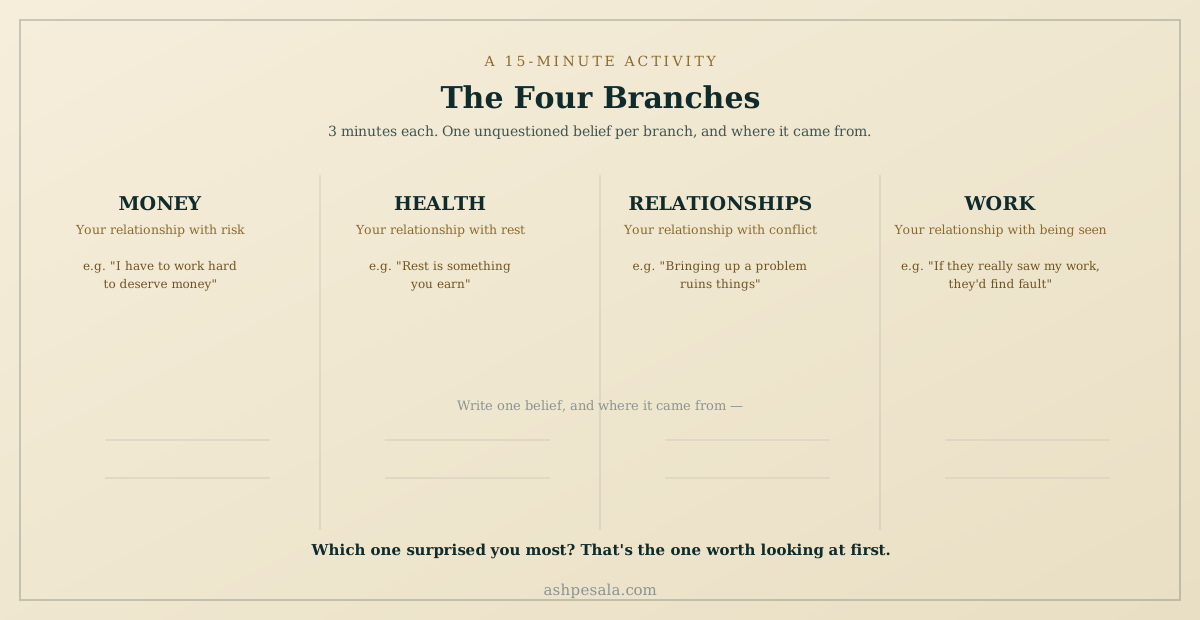
The Four Branches — a 15-minute activity to name one unquestioned belief each in money, health, relationships, and work, and where it came from
Set a timer for 15 minutes. Give each branch — money, health, relationships, work — about 3. For each one, write one belief you've never actually questioned, and where you think it came from. Nothing to submit, no framework to follow. Just answer it, in your own head or written down, and see which one surprises you most. That's usually the one worth looking at first.
You stopped growing at 21
Your body did what it was always going to do. It reached its height and stopped, right on schedule, with your permission or without it.
Your mind was never on that schedule. It's still available, right now, in whatever room you're standing in — your business, your health, the people around you. The only real question is whether you decide to use it, or quietly assume, like most people do, that growing was something that already finished.
Frequently asked
Does personal growth ever actually stop? Not biologically — there's no equivalent age cutoff for mental growth the way there is for height. It slows or stops when someone stops examining their beliefs, not because of any natural limit.
Why doesn't more life experience automatically mean more personal growth? Because experience without reflection tends to repeat rather than grow. You can get very good at working around a pattern without ever actually changing the belief driving it.
Is mental growth really connected to money, health, and relationships, or are those separate? They're connected at the root. Your relationship with risk, rest, and conflict shapes your money, health, and relationships. Treating them as entirely separate skills misses that they usually trace back to the same underlying beliefs.
If this described something you recognized, take the free 60-second assessment or book a confidential call.


Newsletter
Subscribe now to stay updated with top news!
Subscribe to our newsletter and be the first to access exclusive content and expert insights.

